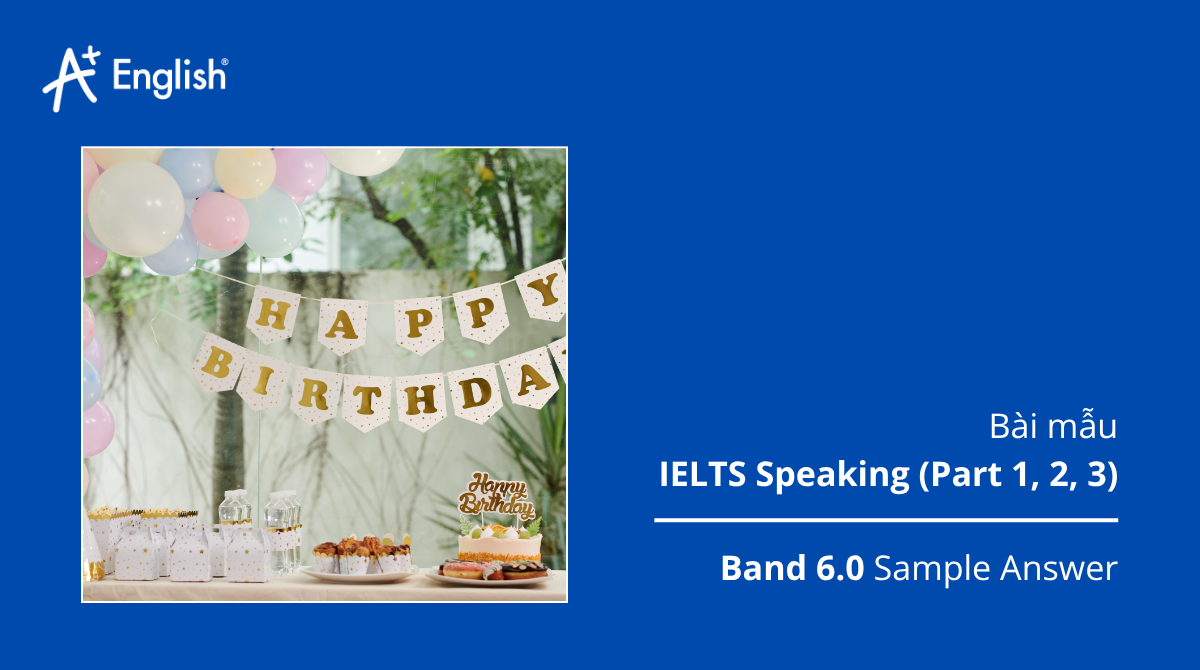
A+ English xin giới thiệu đến các bạn bài mẫu IELTS Speaking band 6.0 với những câu trả lời ấn tượng và tự nhiên, giúp thí sinh ghi điểm cao trong kỳ thi.
Bài mẫu không chỉ gợi ý cách triển khai ý tưởng mạch lạc mà còn cung cấp từ vựng phong phú, cấu trúc câu đa dạng và cách diễn đạt tự nhiên, giúp bạn tự tin giao tiếp và thuyết phục giám khảo.
Hãy cùng khám phá ngay để nâng tầm kỹ năng Speaking của bạn nhé!
1. Đề bài IELTS Speaking (Assignment)
| Task 1:
What qualifications do you hope to get from your studies? Do you meet many people in your job/studies? Why / Why not? What kind of clothes do you wear for work/college? Do you prefer wearing formal or casual clothes? Why? Do you like to get clothes as gifts from friends or family? Why / Why not? |
| Task 2:
Describe a family event you are looking forward to.
Explain why you are looking forward to this family event. |
| Task 3 :
What type of special occasions are generally celebrated in your country? How important is it for families to celebrate occasions together? Why? Are family occasions as important today as they were for former generations? How has the role of elderly people in the family changed in recent times? Who has more power and influence in the family today, young people or grandparents? In the future what kind of units or groups will people live in, do you think? What impact have modern lifestyles had on neighbourhood communities? |
Source: IELTS Practice test Plus 2 TEST 5
2. Phân tích câu hỏi – Lập dàn ý (Analyze the topic – Outline)
Task 1
What qualifications do you hope to get from your studies?
Bằng cấp mong muốn (ví dụ: cử nhân, thạc sĩ…), lý do chọn ngành học.
Do you meet many people in your job/studies? Why / Why not?
Có/Không, vì tính chất công việc/học tập, môi trường năng động hay cá nhân.
What kind of clothes do you wear for work/college?
Đồng phục, quần jeans + áo sơ mi, trang phục lịch sự thoải mái…
Do you prefer wearing formal or casual clothes? Why?
Thích trang phục thường ngày hay trang trọng? Vì thoải mái, hoặc tạo ấn tượng tốt.
Do you like to get clothes as gifts from friends or family? Why / Why not?
Có/Không, vì mang ý nghĩa, thể hiện tình cảm, hoặc không hợp gu.
Task 2
What the event is
Tên sự kiện (ví dụ: đám cưới anh trai)
Where it will be held
Địa điểm: nhà hàng, nhà riêng, ngoài trời…
What you will do at this event
Gặp người thân, chụp hình, ăn uống, phát biểu…
Task 3
What type of special occasions are generally celebrated in your country?
Tết, đám cưới, sinh nhật, lễ Vu Lan, Quốc khánh…
How important is it for families to celebrate occasions together? Why?
Giúp gắn kết, tạo kỷ niệm, duy trì truyền thống.
Are family occasions as important today as they were for former generations?
Kém hơn/xu hướng giảm do bận rộn, nhưng vẫn còn ý nghĩa.
How has the role of elderly people in the family changed in recent times?
Ít quyền hơn, nhưng vẫn được kính trọng; vai trò hỗ trợ con cháu.
Who has more power and influence in the family today, young people or grandparents?
Người trẻ có vai trò quyết định nhiều hơn do tài chính, công nghệ…
In the future what kind of units or groups will people live in, do you think?
Gia đình nhỏ, sống độc lập, nhà thuê/chung cư…
What impact have modern lifestyles had on neighbourhood communities?
Ít giao tiếp, sống khép kín hơn, thiếu gắn bó.
3. Bài Mẫu (Sample Essay) Band 6.0+
Task 1What qualifications do you hope to get from your studies?I aim to complete high school and pursue a university degree in computer science, as I’m passionate about technology and enjoy playing strategy games. Do you meet many people in your job/studies? Why / Why not?Not really. I mostly interact with classmates during school hours and prefer spending my free time playing online games at home. What kind of clothes do you wear for work/college?I usually wear my school uniform, which includes a white shirt and dark trousers. It’s comfortable and appropriate for the school environment. Do you prefer wearing formal or casual clothes? Why?I prefer casual clothes because they’re more comfortable and suit my relaxed lifestyle, especially when I’m gaming or staying indoors. Do you like to get clothes as gifts from friends or family? Why / Why not?Yes, receiving clothes as gifts is nice. It shows they care, even if the style isn’t exactly what I would choose myself. |
Task 2One family event I’m eagerly anticipating is my younger sister’s upcoming birthday party. It will be held at our home, and my parents are planning a small gathering with close family and friends. During the event, I’ll help set up decorations, assist in preparing some dishes, and perhaps even play a few games with the kids.I’m looking forward to this occasion because it’s a chance to bond with my sister and make her day special. Given that I usually keep to myself and don’t often engage in family activities, this event provides an opportunity to step out of my shell. It’s not every day that I get to be the “cool older sibling,” so I’m hoping to make the most of it.Moreover, helping with the preparations allows me to contribute meaningfully to the family, which is something I don’t do often. Cooking a few dishes, even if they’re simple, gives me a sense of accomplishment. It’s like killing two birds with one stone: I get to improve my cooking skills and make my sister happy.In a nutshell, this birthday party is more than just a celebration; it’s an opportunity for personal growth and family bonding. I’m determined to make it a memorable day for my sister and perhaps even for myself. |
Task 3What type of special occasions are generally celebrated in your country?Well, let me think… In Vietnam, we celebrate various occasions such as Tet, which is our Lunar New Year, the Mid-Autumn Festival, and, of course, family gatherings like weddings and birthdays. You know, these events are really an important part of our culture and they provide opportunities for families to come together and enjoy each other’s company. How important is it for families to celebrate occasions together? Why?That’s a good question. I’d say it’s very important because, if you think about it, celebrating together helps strengthen family bonds and creates lasting memories. It’s really a time when members can reconnect, share experiences, and support one another, which I believe is essential for maintaining strong family relationships. Are family occasions as important today as they were for former generations?Hmm… that’s an interesting one. I suppose while the essence of these gatherings still remains, modern lifestyles have made it a bit more challenging to prioritize them. But, even so, many people still recognize how important they are and try their best to keep these traditions alive. How has the role of elderly people in the family changed in recent times?Let me see… I think elderly family members are still respected, but their roles have changed quite a bit. With younger generations becoming more independent, elders often take on more of an advisory role rather than an authoritative one. You could say they guide more than they lead now. Who has more power and influence in the family today, young people or grandparents?That’s a tough one. I guess nowadays, young people tend to have more influence, especially with things like technology and modern education. That said, grandparents still hold a lot of moral authority and they’re definitely valued for their wisdom and life experience. In the future, what kind of units or groups will people live in, do you think?Hmm… that’s something to think about. I believe we’ll see more nuclear families and individual living arrangements, mostly because of urbanization and the growing preference for independence. People seem to value their personal space more than before. What impact have modern lifestyles had on neighborhood communities?Well, from what I’ve seen, modern lifestyles have led to less interaction among neighbors. You know, people are often busy with work or other personal commitments, so that kind of creates a sense of isolation in communities. It’s a bit of a shame, really. |
Dịch
| Task 1
Bạn hy vọng sẽ đạt được những bằng cấp gì từ việc học của mình? Bạn có thích được tặng quần áo từ bạn bè hoặc gia đình không? Tại sao / Tại sao không? |
| Task 2
Một sự kiện gia đình mà mình đang rất mong đợi là sinh nhật sắp tới của em gái mình. Bữa tiệc sẽ được tổ chức tại nhà, và bố mẹ mình đang chuẩn bị một buổi tụ họp nhỏ với người thân và bạn bè thân thiết. Trong buổi tiệc, mình sẽ giúp trang trí, phụ nấu một vài món ăn và có thể sẽ chơi vài trò chơi với lũ trẻ.Mình háo hức với dịp này vì đây là cơ hội để gắn bó với em gái và khiến ngày của em trở nên đặc biệt. Vì bình thường mình khá kín tiếng và ít tham gia các hoạt động gia đình, nên sự kiện này cũng là dịp để mình “bước ra khỏi vỏ ốc”. Không phải ngày nào cũng có cơ hội trở thành “người anh trai ngầu”, nên mình muốn tận dụng thật tốt cơ hội này.Hơn nữa, việc tham gia chuẩn bị cho bữa tiệc giúp mình cảm thấy mình đang đóng góp một điều gì đó ý nghĩa cho gia đình – điều mà mình không thường xuyên làm. Dù chỉ là nấu vài món đơn giản, nhưng điều đó cũng mang lại cảm giác tự hào. Nó giống như “một mũi tên trúng hai đích”: vừa cải thiện kỹ năng nấu ăn, vừa khiến em gái vui.Tóm lại, bữa tiệc sinh nhật này không chỉ đơn thuần là một buổi lễ kỷ niệm; nó còn là cơ hội để phát triển bản thân và gắn kết gia đình. Mình thật sự quyết tâm sẽ biến ngày hôm đó thành một kỷ niệm đáng nhớ cho em gái – và có thể là cả cho chính mình nữa. |
| Task 3
Những dịp đặc biệt nào thường được tổ chức ở đất nước bạn? Việc gia đình cùng nhau tổ chức những dịp đặc biệt quan trọng như thế nào? Tại sao? Ngày nay, các dịp gia đình có còn quan trọng như đối với các thế hệ trước không? Vai trò của người lớn tuổi trong gia đình đã thay đổi như thế nào trong thời gian gần đây? Ngày nay, ai có ảnh hưởng lớn hơn trong gia đình – người trẻ hay ông bà? Trong tương lai, bạn nghĩ mọi người sẽ sống trong những nhóm hay đơn vị gia đình nào? Lối sống hiện đại đã ảnh hưởng như thế nào đến cộng đồng hàng xóm? |
4. Từ vựng (Vocabulary)
- Accomplishment /əˈkʌm.plɪʃ.mənt/ – (B2,n): Thành tựu, sự hoàn thành
Collocations: personal accomplishment (thành tựu cá nhân), sense of accomplishment (cảm giác hoàn thành)
Example Sentence: Cooking a few dishes gives me a sense of accomplishment.
Translation: Việc nấu vài món ăn mang lại cho tôi cảm giác hoàn thành. - Anticipate /ænˈtɪs.ɪ.peɪt/ – (B2,v): Mong đợi, trông đợi
Collocations: eagerly anticipate (háo hức mong chờ), anticipate problems (dự đoán vấn đề)
Example Sentence: One family event I’m eagerly anticipating is my younger sister’s birthday.
Translation: Một sự kiện gia đình mà tôi rất mong đợi là sinh nhật của em gái tôi. - Bond /bɒnd/ – (B2,n): Mối quan hệ, sự gắn bó
Collocations: family bond (mối gắn bó gia đình), emotional bond (mối quan hệ cảm xúc)
Example Sentence: Celebrating together strengthens family bonds.
Translation: Cùng nhau ăn mừng làm gia tăng sự gắn bó trong gia đình. - Memorable /ˈmem.ər.ə.bəl/ – (B2,adj): Đáng nhớ
Collocations: memorable day (ngày đáng nhớ), memorable experience (trải nghiệm đáng nhớ)
Example Sentence: I’m determined to make it a memorable day for my sister.
Translation: Tôi quyết tâm biến đó thành một ngày đáng nhớ cho em gái mình. - Independent /ˌɪn.dɪˈpen.dənt/ – (B2,adj): Độc lập
Collocations: become independent (trở nên độc lập), financially independent (độc lập tài chính)
Example Sentence: With younger generations becoming more independent, elders take on advisory roles.
Translation: Khi thế hệ trẻ trở nên độc lập hơn, người lớn tuổi đảm nhận vai trò cố vấn. - Contribute /kənˈtrɪb.juːt/ – (B2,v): Đóng góp
Collocations: contribute to the community (đóng góp cho cộng đồng), meaningfully contribute (đóng góp có ý nghĩa)
Example Sentence: Helping with the preparations allows me to contribute meaningfully to the family.
Translation: Việc giúp chuẩn bị cho phép tôi đóng góp một cách có ý nghĩa cho gia đình. - Interaction /ˌɪn.təˈræk.ʃən/ – (B2,n): Sự tương tác
Collocations: social interaction (tương tác xã hội), face-to-face interaction (tương tác trực tiếp)
Example Sentence: Modern lifestyles have led to decreased interaction among neighbors.
Translation: Lối sống hiện đại đã làm giảm sự tương tác giữa các hàng xóm. - Urbanization /ˌɜː.bən.aɪˈzeɪ.ʃən/ – (B2,n): Sự đô thị hóa
Collocations: rapid urbanization (đô thị hóa nhanh),effects of urbanization (tác động của đô thị hóa)
Example Sentence: There will be a rise in nuclear families due to urbanization.
Translation: Sẽ có sự gia tăng các gia đình hạt nhân do đô thị hóa. - Engage /ɪnˈɡeɪdʒ/ – (B2,v ): Tham gia, gắn kết
Collocations:engage in activities (tham gia hoạt động), actively engage (tích cực tham gia)
Example Sentence: I don’t often engage in family activities.
Translation: Tôi không thường tham gia vào các hoạt động gia đình. - Gathering /ˈɡæð.ər.ɪŋ/ – (B2,n): Buổi tụ họp
Collocations: family gathering (tụ họp gia đình), small gathering (tụ họp nhỏ)
Example Sentence: My parents are planning a small gathering with family and friends.
Translation: Bố mẹ tôi đang lên kế hoạch một buổi tụ họp nhỏ với gia đình và bạn bè.
5. Thành ngữ (Idioms)
- Kill two birds with one stone : Một công đôi việc
Example Sentence: It’s like killing two birds with one stone: I get to improve my cooking skills and make my sister happy.
Translation: Nó giống như một công đôi việc: tôi vừa cải thiện kỹ năng nấu ăn của mình vừa làm em gái tôi hạnh phúc. - Step out of (one’s) shell : Thoát ra khỏi vỏ bọc, trở nên cởi mở hơn
Example Sentence: This event provides an opportunity to step out of my shell.
Translation: Sự kiện này cho tôi cơ hội thoát ra khỏi vỏ bọc của mình. - Make the most of something : Tận dụng tối đa điều gì đó
Example Sentence: I’m hoping to make the most of it.
Translation: Tôi hy vọng sẽ tận dụng tối đa điều đó. - Keep to oneself : Sống khép kín, không chia sẻ hay giao tiếp nhiều
Example Sentence: I usually keep to myself and don’t often engage in family activities.
Translation: Tôi thường sống khép kín và không thường tham gia vào các hoạt động gia đình. - Bond with someone : Gắn kết, tạo mối quan hệ thân thiết với ai đó
Example Sentence: It’s a chance to bond with my sister and make her day special.
Translation: Đó là cơ hội để gắn kết với em gái tôi và làm cho ngày của cô ấy trở nên đặc biệt.
6. Ngữ pháp
1. It’s like + V-ing / Clause
- Công thức chung: It’s like + V-ing / Clause
- Nghĩa tiếng Việt: Giống như việc…, giống như là…
- Bối cảnh sử dụng: Dùng để ví von, đưa ra so sánh trong khi nói
- Câu ví dụ: It’s like killing two birds with one stone.
- Dịch câu: Nó giống như một công đôi việc.
2. Be looking forward to + V-ing / Noun
- Công thức chung: Be + looking forward to + V-ing/N
- Nghĩa tiếng Việt: Mong đợi điều gì
- Bối cảnh sử dụng: Dùng khi nói về điều gì đó sắp xảy ra mà mình rất trông chờ
- Câu ví dụ: I’m looking forward to this occasion.
- Dịch câu: Tôi đang mong đợi dịp này.
3. Allow + O + to V
- Công thức chung: Allow + object + to V
- Nghĩa tiếng Việt: Cho phép ai đó làm gì
- Bối cảnh sử dụng: Dùng để nói về một hành động tạo điều kiện cho người khác
- Câu ví dụ: Helping with the preparations allows me to contribute meaningfully.
- Dịch câu: Việc chuẩn bị cho phép tôi đóng góp một cách có ý nghĩa.
4. While + Clause (contrast)
- Công thức chung: While + mệnh đề
- Nghĩa tiếng Việt: Trong khi…, mặc dù…
- Bối cảnh sử dụng: Dùng để tương phản giữa hai vế trong một câu
- Câu ví dụ: While the essence remains, modern lifestyles have made it challenging to prioritize family gatherings.
- Dịch câu: Mặc dù bản chất vẫn còn, lối sống hiện đại khiến việc ưu tiên cho các buổi tụ họp gia đình trở nên khó khăn.
5. There will be + N (dự đoán tương lai)
- Công thức chung: There will be + danh từ (Noun)
- Nghĩa tiếng Việt: Sẽ có…
- Bối cảnh sử dụng: Dùng để dự đoán hay nói về điều gì đó sẽ xảy ra trong tương lai
- Câu ví dụ: There will be a rise in nuclear families and individual living arrangements.
- Dịch câu: Sẽ có sự gia tăng các gia đình hạt nhân và hình thức sống riêng lẻ.
7. Các hình thái thể hiện sự lưu loát
Use of Cohesive Devices (Logical Connectors, Pronouns, Conjunctions):
- Logical connectors: However, Moreover, While, Because
- Pronouns: it, they, this, which
- Conjunctions: and, but, so, although
Spoken Language Style:
- Câu được ngắt nhịp ngắn để nhấn mạnh thông tin chính
- It’s not every day that I get to be the “cool older sibling.” → ngừng ở “every day” giúp tăng độ nhấn mạnh.
- “To be honest, online shopping saves a lot of time.”
- Từ nối tự nhiên khi nói: So, yeah… Well, to be honest…And then…
- Các cụm tự nhiên trong lời nói: you know, I mean, actually, sort of/kind of
8. Phát âm
1. Meaningful Utterances (Chunks)
- Chia câu thành các cụm từ ngắn có nghĩa để giúp việc nói trôi chảy và tự nhiên hơn.
- Example:
- I’m looking forward / to this occasion.
- Helping with the preparations / allows me / to contribute meaningfully.
Rhythm:
- Nhấn mạnh các từ quan trọng như danh từ, động từ, tính từ.
- Giảm âm các từ chức năng như giới từ, mạo từ để nói tự nhiên hơn.
- Example:
- I usually wear my school uniform, which includes a white shirt and dark trousers. → Nhịp điệu đều đặn, chia cụm theo nhịp tự nhiên giúp nói trôi chảy hơn.
- Modern lifestyles have led to decreased interaction among neighbors. → Câu được chia đều thành các nhịp để dễ phát âm liên tục và rõ ràng.
Elision:
- Dropping unnecessary sounds in casual speech to produce smoother and faster speech.
- Example:
- I’m looking forward t’this occasion. (nối âm “to + this”)
- Make the mos(t) of it (âm “t” rơi nhẹ, elision)
- Bond with my sister → “bond-with” nối liền
3. Stress and Intonation
- Nhấn mạnh từ quan trọng để thể hiện sự quan tâm hoặc cảm xúc.
- Example:
- I’m determined to make it a memorable day for my sister. → Từ “determined” và “memorable” được nhấn để thể hiện cảm xúc và ý định rõ ràng.
- Yes, receiving clothes as gifts is nice. → Từ “nice” có trọng âm rõ để truyền đạt cảm xúc tích cực, ngữ điệu tăng ở cuối thể hiện sự đồng tình.
Contrastive Stress
- Nhấn mạnh hai từ để làm nổi bật sự khác biệt hoặc tương phản.
- Example:
- I prefer casual clothes because they’re more comfortable. → Nhấn vào “casual” để đối lập với “formal” (ngầm hiểu từ câu trước).
- While the essence remains, modern lifestyles have changed priorities. → Nhấn vào “essence remains” để làm nổi bật sự tương phản với “modern lifestyles.”
9. Bài luyện tập (Practice Exercise)
Bài tập dịch từ tiếng Việt qua tiếng Anh:
Bài tập viết lại câu:
|
| KEY
Bài tập dịch từ tiếng Việt qua tiếng Anh:
Bài tập viết lại câu:
|
Sau khi tham khảo bài mẫu IELTS Speaking – Band 6.0, A+ English hy vọng các bạn sẽ hiểu rõ cách triển khai câu trả lời, phát triển ý tưởng mạch lạc. Đồng thời, các bạn cũng sẽ thu thập thêm nhiều từ vựng, cấu trúc hay và cách diễn đạt tự nhiên để áp dụng trong kỳ thi.
Nếu bạn đang tìm một khóa học IELTS chất lượng cao, phù hợp với trình độ của mình, hãy liên hệ ngay Tại đây để được tư vấn lộ trình học cá nhân hóa và nhận những tài liệu độc quyền mới nhất!
A+ English chúc các bạn học tập hiệu quả!